Winter Wiggles: The #4 Dog Behavior Problem of 2025
It's 7:30 PM on a Tuesday in December. The temperature outside has plummeted, darkness fell hours ago, and your normally well-behaved dog is now racing through the house like a furry tornado. The pillows from your couch have mysteriously migrated to the floor, there's a new chew mark on your coffee table leg, and the barking—oh, the barking—every time a snowplow rumbles past.
Sound familiar? You're experiencing what we at Clever Canine call "The Winter Wiggles"—our #4 most common dog behavior problem of 2025.
As we count down the top dog training challenges this year, winter-induced behavior problems have earned this spot because they affect nearly every dog owner at some point. The good news? With the right approach, these behaviors are also among the most solvable.
The Winter Wiggles Explained: Why Your Dog Goes Wild When It's Cold
The Winter Wiggles isn't just one behavior—it's a constellation of unwanted behaviors that emerge or intensify during winter months when dogs spend more time indoors with less physical and mental stimulation.
Your dog isn't trying to drive you crazy (although it might feel that way). Dogs evolved to be active, curious creatures with daily needs for both physical exercise and mental engagement. When winter restricts their usual outlets, that energy doesn't simply disappear—it transforms into behaviors that often make owners consider banishment to the backyard (despite the snow).
The Science Behind the Wiggles
Dogs' brains release dopamine—the "feel good" neurotransmitter—when they engage in physical activity and when they solve problems. Without these dopamine releases, dogs become stressed and frustrated, leading to behaviors that self-soothe or self-stimulate.
This manifests in three primary ways:
1. Destructive Chewing
When Bailey, a 2-year-old Goldendoodle, destroyed her owner's favorite boots last January, it wasn't revenge for shorter walks. Chewing releases endorphins in dogs' brains, creating a calming effect. Without adequate exercise and enrichment, dogs turn to inappropriate items to create their own satisfaction.
Signs you're dealing with this:
Targeting items with your scent (shoes, remote controls)
Focusing on corners of furniture, baseboards, or door frames
Shredding paper, pillows, or soft items
The destruction happens primarily when left alone
2. Excessive Barking/Whining
The constant "woofs" at every sound outside or the whining that seems to have no specific cause are your dog's way of releasing pent-up energy and expressing frustration.
Signs you're dealing with this:
Barking increases dramatically in winter months
Alert barking at minor sounds intensifies
Demand barking for attention escalates
Whining or "talking back" when asked to settle
3. Hyperactivity/Zoomies
Those wild bursts of energy where your dog races around the house, bounces off furniture, or spins in circles are actually called Frenetic Random Activity Periods (FRAPs) by behaviorists. While occasional zoomies are normal, frequent indoor episodes signal inadequate energy outlets.
Signs you're dealing with this:
Multiple zoomie episodes daily
Difficulty settling down in the evening
Excessive jumping on people
Rough play or mouthing that intensifies in winter
The Clever Canine Approach: Solving Winter Wiggles
Last winter, Mark from Troy came to us desperate for help with his Labrador, Bentley. "He's turned my living room into a racetrack and my throw pillows into confetti," Mark told us. "I love him, but I'm at my wit's end."
Three weeks later, Mark sent us a photo of Bentley calmly lying on the couch next to him. "I didn't think this was possible in winter," he wrote.
What changed? Mark implemented our multi-faceted approach to conquering Winter Wiggles:
Indoor Physical Exercise Alternatives
While nothing completely replaces a good outdoor romp, these activities help maintain physical fitness:
Stair Work: Having your dog go up and down stairs (supervised) provides excellent exercise in a small space. Start with 5 repetitions and build up gradually.
Indoor Fetch with Soft Toys: Clear a hallway for a gentle game of fetch with soft toys. Rolling the toy rather than throwing reduces the risk of household damage.
Tug Games with Rules: Structured tug games that include commands like "take it," "drop it," and regular pauses provide physical outlet while reinforcing training.
Flirt Pole: A smaller indoor version of this toy (essentially a pole with a rope and toy attached) allows for controlled movement in a smaller space.
Mental Stimulation: The Secret Weapon
Mental exercise can be even more tiring than physical exercise for many dogs. A 20-minute sniffing session can exhaust a dog more than a 30-minute walk.
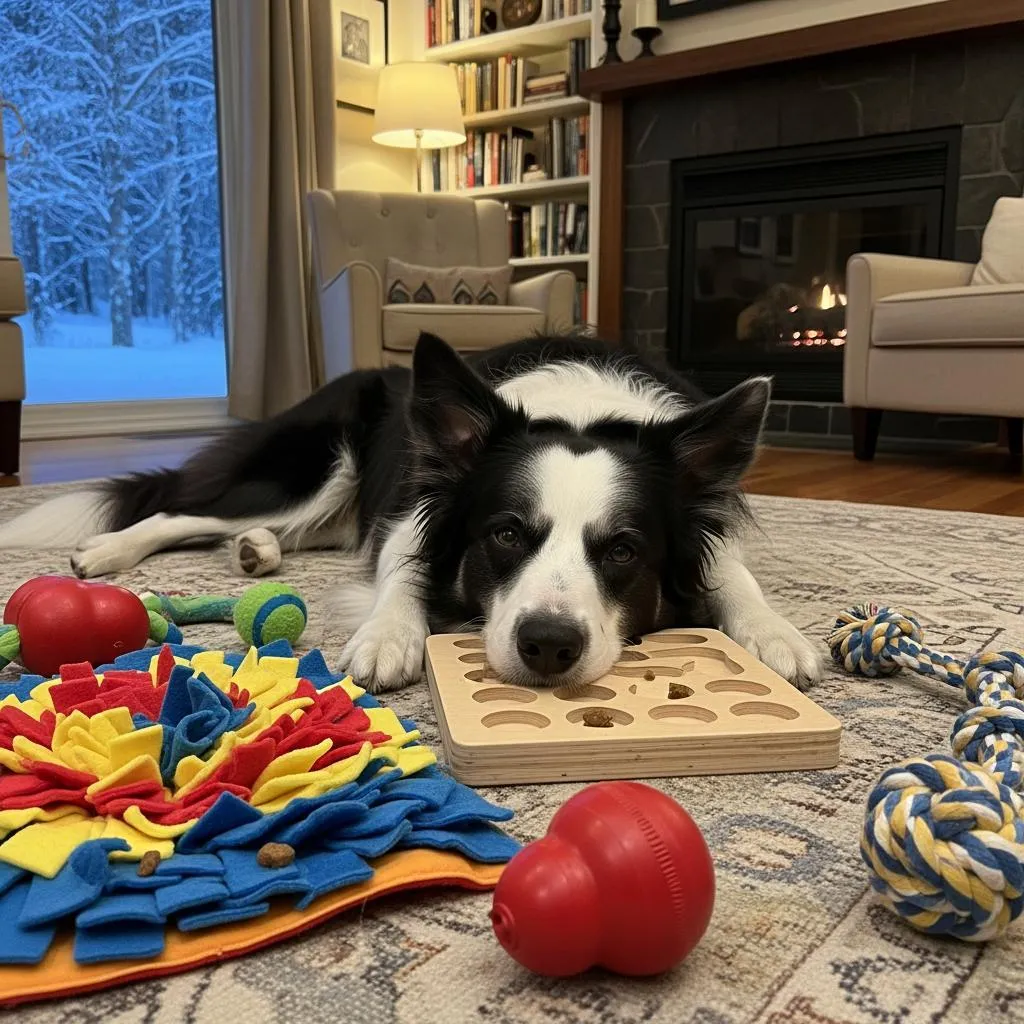
Food Puzzles: Ditch the bowl and make meals an activity. Puzzle feeders, snuffle mats, and treat-dispensing toys transform eating into mentally stimulating work.
Scent Games: Hide treats or toys around the house and encourage your dog to find them. Start easy and gradually increase difficulty.
New Tricks Training: Winter is the perfect time to teach new behaviors. Even 5-10 minute sessions a few times daily provide significant mental exercise.
Rotation System: Keep 3-4 different puzzle toys and rotate them every few days to maintain novelty and interest.
Training Exercises That Tire the Mind
These specific exercises build impulse control—the mental muscle that helps dogs manage their energy:
"Go to Place": Teaching a solid "go to your bed/mat" command creates a calming default behavior.
Duration Stays: Gradually building the length of time your dog can hold a sit or down stay builds mental endurance.
The "Settle" Command: Teaching your dog to deliberately relax on cue is invaluable during winter months.
"Find It" Games: Hide treats under cups or toys and have your dog use their nose and brain to locate them.
Environmental Management Strategies
Sometimes, preventing problems is as important as solving them:
Designated Chew Station: Create a specific area with appropriate chew items that are more appealing than your furniture.
Barrier Management: Use baby gates or exercise pens to limit access to problem areas when supervision isn't possible.
Background Noise: White noise machines or classical music can reduce alert barking triggered by outdoor sounds.
Enrichment Rotation: Create a schedule that ensures your dog receives different types of enrichment throughout the day.
Client Success Story: How Max Overcame the Winter Wiggles
Emma was at her breaking point with Max, her Border Collie mix. Last winter, she was working from home while Max barked incessantly at the window, chewed through two charging cables, and seemed to have an endless supply of energy despite the freezing temperatures outside.
"I was seriously questioning if we were the right match," Emma admitted. "I couldn't get any work done, and Max seemed miserable too."
After just two sessions focusing on mental enrichment and impulse control, Emma reported a 70% improvement in Max's behavior. By implementing a structured daily routine that included puzzle feeders, training sessions, and indoor games, Max transformed from a winter terror to a content companion.
"The most surprising thing was how much the mental exercises tired him out," Emma told us. "A 15-minute session with the snuffle mat actually calmed him down more than our summer walks used to!"
Your 7-Day Winter Wiggles Solution
Ready to transform your winter experience? Here's a day-by-day plan to implement these solutions:
Day 1: Assessment & Foundation
Track current problem behaviors (type, frequency, timing)
Introduce one food puzzle at mealtime
Practice "settle" command for 3-5 minutes, three times today
Create a designated chew station with 3-4 appropriate items
Day 2: Physical Foundations
Implement 3 mini exercise sessions (5 minutes each)
Replace one regular meal with a puzzle feeder
Practice "go to place" command for 5 minutes, twice today
Rotate chew toys from yesterday with new options
Day 3: Mental Stimulation Focus
Introduce simple scent work (hiding treats in easy spots)
Add a second puzzle feeding
Practice 3-minute duration stays
Begin using a white noise machine or calming music
Day 4: Combine Physical & Mental
Implement structured tug game with obedience breaks
Try a new food puzzle or feeding method
Practice "find it" games with favorite toys
Begin barrier management in problem areas
Day 5: Increase Duration
Extend mental exercise sessions to 10 minutes
Practice longer duration stays (5+ minutes)
Introduce indoor fetch with rules
Rotate to new chew toys
Day 6: Routine Establishment
Create a consistent daily schedule
Combine multiple types of enrichment
Practice all commands in different locations
Identify which solutions show the most promise
Day 7: Refinement
Focus on the techniques that worked best
Create a sustainable winter routine
Address any remaining problem areas
Celebrate your progress!
Quick-Win Activities for Immediate Results
Need relief right now? These activities can help calm an over-excited dog in 15 minutes or less:
Frozen Kong: A Kong stuffed with wet food or peanut butter and frozen can provide 20+ minutes of focused activity.
Sniff Walk: Even a quick 5-minute sniffing session in your yard (regardless of temperature) can reset your dog's brain.
Relaxation Protocol: This structured relaxation exercise (easily found online) can help teach your dog to calm down.
Empty House Search: Hide 10-15 treats around one room while your dog waits in another room, then let them search.
Building a Sustainable Winter Routine
The key to winter success is consistency. Dogs thrive on routine, and knowing what to expect helps them manage their energy.
A balanced winter day might include:
Morning puzzle feeding
Midday training session (5-10 minutes)
Afternoon scent game or indoor exercise
Evening chew time with appropriate toys
Consistent bedtime routine
Remember that prevention is easier than correction. Implementing these strategies before problem behaviors escalate will yield the best results.
Moving Forward: Your Winter Doesn't Have to Be Wild
The Winter Wiggles may be the #4 dog behavior problem of 2025, but with consistent application of these strategies, your dog can be the exception to the rule. A calm, content canine companion during the winter months is absolutely achievable.
Next week, we'll reveal the #3 most common dog behavior problem of 2025. (Hint: It involves doorways and might be happening at your home during holiday gatherings!)
If you're struggling with Winter Wiggles that seem beyond self-management, we're here to help. Many Metro Detroit dogs need a little extra guidance during our challenging winters.
Call me at (248) 618-3258 or email [email protected] to discuss how we can transform your dog's winter behavior. Our proven Canine Connection Compass methodology has helped hundreds of Metro Detroit dogs channel their winter energy constructively and find their indoor calm.
Remember, you don't have to face the Winter Wiggles alone—a calmer winter with your dog is just a phone call away.
Happy training!
Mandy Majchrzak
Owner and Head Trainer
Clever Canine Dog Training
Metro Detroit's Family Dog Training Specialists