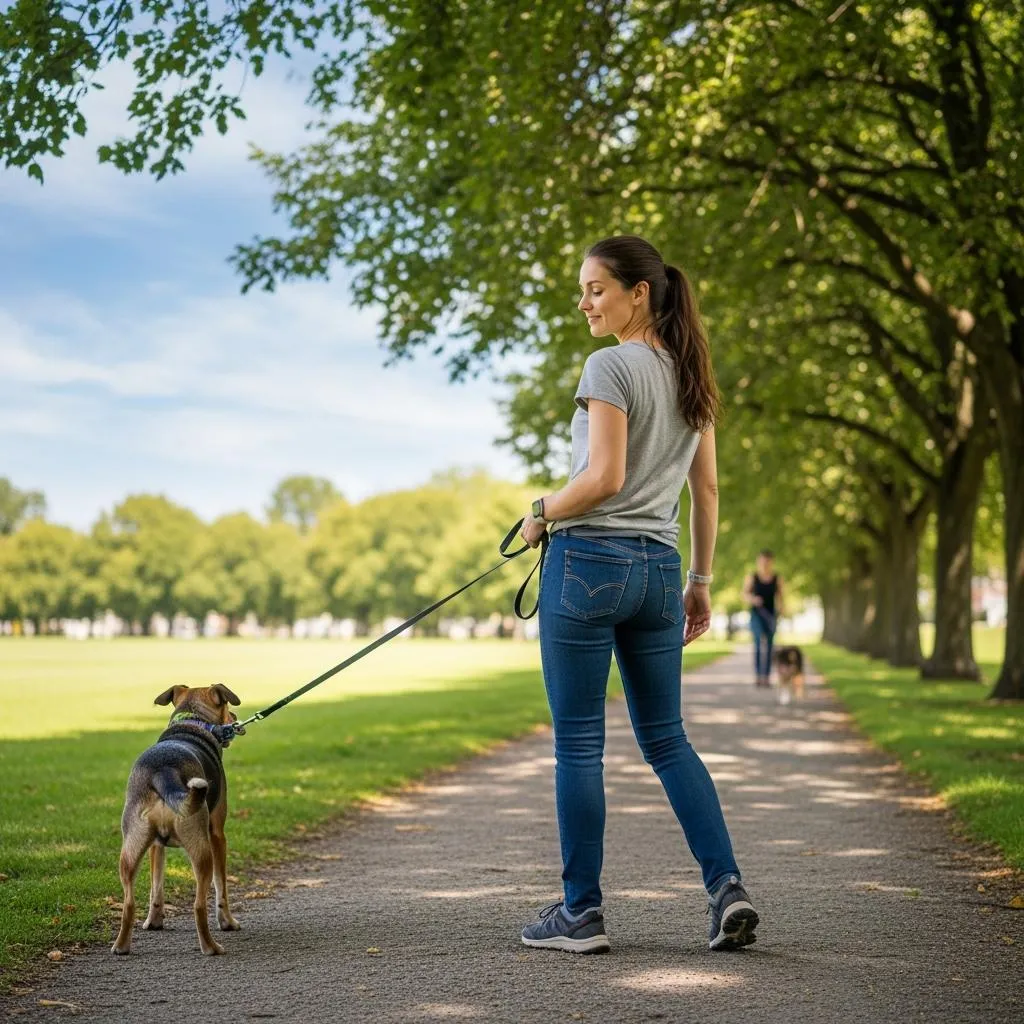
Professional dog trainer demonstrating the U-Turn Walk technique with a leash reactive dog, calmly redirecting the dog's attention away from a distant trigger while maintaining relaxed leash position in a park setting.

Transform Chaotic Walks: 5 Immediate Solutions for Leash Reactive Dogs
September 26, 202513 min read

Transform Chaotic Walks: 5 Immediate Solutions for Leash Reactive Dogs

Picture this: You're enjoying a peaceful morning walk when suddenly your dog spots another dog across the street. In an instant, your relaxing stroll transforms into a chaotic struggle as your dog lunges, barks, and pulls with surprising strength. Your cheeks burn with embarrassment as neighbors peek out their windows, and the other dog owner gives you "that look."

If this scenario sounds painfully familiar, you're not alone. As a dog trainer serving families throughout Metro Detroit, I work with countless clients whose dogs react to other dogs, joggers, cyclists, or strollers while on leash. What should be an enjoyable activity becomes a source of stress, embarrassment, and sometimes even isolation.

Many of my clients admit they've started walking at odd hours, driving to remote locations, or even avoiding walks altogether just to escape the anxiety of managing their reactive dog in public. One client from Rochester Hills told me she would wake up at 5:00 AM every morning – even in Michigan's harsh winters – just to walk her dog when no one else would be around.

The good news? You don't have to live this way forever. While completely resolving leash reactivity takes time and consistency, there are immediate strategies you can implement today to make your walks more manageable. Let's dive into five practical solutions that my clients have used successfully to transform their daily walks from stressful ordeals into enjoyable outings.

Understanding Reactivity: A Quick Primer

Before jumping into solutions, let's quickly understand what's happening when your dog reacts on leash. Contrary to what many assume, leash reactivity isn't necessarily aggression – it's typically frustration, fear, or overexcitement that your dog can't express naturally because they're restrained by a leash.

Your dog might be thinking:

  • "I want to greet that dog but I can't get there!" (frustration)

  • "That strange dog looks scary and I can't escape!" (fear)

  • "I'm so excited to see another dog I don't know how to contain myself!" (overarousal)

Add to this the tension that travels down the leash from you (because you're anticipating a reaction), and you have the perfect storm for reactive behavior.

Common misunderstandings about leash reactivity:

  1. "My dog is just being dominant" – In reality, most reactive behavior stems from insecurity, not dominance.

  2. "My dog is aggressive and wants to attack" – Many reactive dogs are actually fine with other dogs off-leash in controlled settings; the leash creates the problem by limiting normal greeting behaviors and escape options.

  3. "My dog is just poorly trained" – While training helps manage reactivity, it's often an emotional response, not a training issue per se.

  4. "If I just correct my dog strongly enough, they'll stop" – Punishment often increases reactivity by adding stress to an already stressful situation.

Understanding that reactivity is usually driven by emotion rather than disobedience helps us approach solutions with empathy while still maintaining clear boundaries. Now, let's get to those solutions you can implement immediately.

Strategy 1: Master the "U-Turn Walk" Technique

The "U-Turn Walk" is one of the simplest yet most effective techniques for managing reactivity in the moment. It's exactly what it sounds like – a smooth, calm change of direction before your dog goes over threshold.

How to do it:

  1. Keep an eye on the environment and watch for your dog's triggers (other dogs, joggers, etc.)

  2. Before your dog notices the trigger (or immediately when they notice but before they react), use an upbeat voice to say "This way!" or "Let's go!"

  3. Simultaneously, make a smooth U-turn and walk in the opposite direction

  4. Reward your dog with praise and treats for following you

Why it works: This technique prevents your dog from rehearsing reactive behavior, which is crucial since every time your dog practices barking and lunging, it strengthens that response. The U-turn also helps your dog learn to trust that you'll handle potentially threatening situations, building your relationship.

Success story: Lisa from Troy couldn't walk her German Shepherd mix without embarrassing lunging episodes that left her feeling helpless and frustrated. After practicing the U-turn technique for just two weeks, she reported being able to avoid 90% of reactive incidents, making walks enjoyable again. "I used to dread walking Maximus," she told me. "Now I actually look forward to our walks because I feel in control of the situation."

Pro tip: The key is timing – don't wait until your dog is already barking and lunging. Watch for early signs like:

  • Ears perking up or forward

  • Sudden stillness or staring

  • Hair raising on their back (hackles up)

  • Stiffening body posture

  • Closed mouth that suddenly opens

  • Weight shifting forward

Make your U-turn at the first hint of awareness, before your dog has fully processed the trigger's presence.

Common mistakes to avoid:

  • Jerking the leash during the turn (creates negative associations)

  • Using a stern or anxious voice (transfers your tension to your dog)

  • Turning too slowly (gives your dog time to fully react)

  • Forgetting to reward after a successful turn

Practice this technique in low-distraction environments first so both you and your dog become fluent in the movement before trying it in challenging situations.

Strategy 2: The "Look at That" Game for Desensitization

This game, popularized by trainer Leslie McDevitt in her Control Unleashed program, helps your dog learn that looking at triggers calmly earns rewards. Over time, this builds a positive association with the very things that used to cause reactions.

How to play:

  1. Start at a distance where your dog notices the trigger but remains calm (this is critical!)

  2. The moment your dog looks at the trigger, say "Yes!" and give a high-value treat

  3. Repeat this process: look at trigger → "Yes!" → treat

  4. Over multiple sessions, gradually decrease the distance to the trigger as your dog remains calm

The psychology: This technique works because it changes your dog's emotional response. Instead of "Dog = Panic," they begin to learn "Dog = Treats and Calm." It also gives your dog a new job to do when they see a trigger – look at it calmly, then look back at you for reinforcement.

Step-by-step implementation:

Phase 1: Introduction

  • Find a location where triggers will appear at a safe distance (perhaps a quiet park bench far from the main path)

  • Mark and reward any calm looking behavior toward distant triggers

  • Practice for 5-10 minutes, keeping sessions positive and successful

Phase 2: Adding a cue

  • Once your dog understands the game, add a cue like "Look at that!" before they notice the trigger

  • This helps them start associating the phrase with the behavior

  • Continue marking and rewarding calm looking behavior

Phase 3: Decreasing distance

  • Very gradually decrease your distance from triggers

  • If your dog shows any signs of stress, increase distance immediately

  • Success builds on success – don't rush this process

When to practice: Begin in low-distraction environments with mild triggers, then gradually work up to more challenging scenarios. Neighborhood walks during quieter times of day are perfect for practice.

Success story: Mike from Ferndale had a Border Collie mix who would lunge and bark frantically whenever she saw another dog, even at a distance. After three weeks of consistent "Look at That" practice, his dog could calmly observe other dogs from 30 feet away and immediately look back at him for a treat. "It's like she's saying 'Dad, I saw that dog, where's my cookie?' instead of losing her mind," Mike explained.

Strategy 3: Equipment Solutions That Actually Help

The right equipment won't fix reactivity, but it can give you better control while you work on training. Here's what actually helps:

Head halters: Products like the Gentle Leader provide excellent control for stronger dogs, but require proper conditioning and fitting.

Benefits:

  • Gives control of the dog's head direction

  • Creates significant mechanical advantage for handlers

  • Can calm some dogs through gentle pressure points

Important note: Head halters must be properly introduced with positive associations over 1-2 weeks. Never jerk or pull harshly on a head halter as it can injure your dog's neck.

Double-connection systems: Using both a martingale and a well-fitted collar with a double-ended leash gives you optimal control during reactive moments.

Benefits:

  • Two points of contact for better control

  • Backup safety if one connection fails

  • Ability to direct your dog's body and head separately

What to avoid:

  • Retractable leashes (they don't provide adequate control and can cause injuries)

  • Constantly switching equipment (confuses your dog and prevents mastery)

Finding the right fit: Every dog is different, so what works for one may not work for another. When clients visit our training center, we often try several options to find the best match for their specific dog's body type and reactivity pattern.

Important note: No equipment replaces training, but the right tools can help you maintain control while you work on the underlying issues. Think of good equipment as a management tool that creates the space for successful training to occur.

Strategy 4: The "Emergency Scatter" Technique

When you're caught off guard and your dog is about to react, the Emergency Scatter technique can interrupt the reaction pattern.

How it works:

  1. Carry a handful of high-value treats in an easily accessible pocket

  2. If you suddenly encounter a trigger and your dog is about to react, toss the treats in a scatter pattern on the ground

  3. As your dog focuses on finding the treats, use that time to create distance from the trigger

  4. Once at a safer distance, regain your dog's attention and continue walking

Why it works: This technique uses your dog's natural foraging instinct to interrupt the reaction cycle. It buys you precious seconds to move away from the trigger while giving your dog something positive to do instead of reacting.

When to use it:

  • When a trigger appears suddenly around a corner

  • When you're surprised by an off-leash dog

  • When you can't create distance quickly enough

  • When your dog is already starting to react

Pro tip: Use smelly, high-value treats that will immediately capture your dog's attention – small pieces of chicken, cheese, or freeze-dried liver work well. Practice the scatter technique at home first so your dog understands the game.

Success story: Jen from Sterling Heights has a reactive Beagle mix who would lunge and bark wildly whenever bicycles passed. After learning the Emergency Scatter technique, she successfully used it when a cyclist unexpectedly rounded a corner. "Normally, Charlie would have gone ballistic," she said, "but he was so focused on finding those treats that he barely noticed the bike. By the time he looked up, the cyclist was far enough away that Charlie stayed calm. It was amazing!"

Important note: This is an emergency management technique, not a long-term training solution. Use it sparingly when needed, while continuing to work on the underlying reactivity.

Strategy 5: Threshold Training for Long-Term Success

While the previous strategies help manage reactions in the moment, threshold training helps address the underlying reactivity.

Understanding threshold: Your dog's "threshold" is the distance at which they can notice a trigger but still remain calm and responsive to you. Beyond this distance, their brain goes into fight-or-flight mode.

How to implement threshold training:

  1. Find your dog's current threshold distance (might be 50 feet from other dogs for some, 100+ feet for others)

  2. Practice sitting calmly at this distance while triggers are present, rewarding calm behavior

  3. If your dog remains calm for several sessions, decrease the distance slightly (5-10 feet)

  4. If your dog reacts, increase the distance – you've gone beyond threshold

  5. Gradually work closer to triggers over weeks and months

The science behind it: This approach works because it keeps your dog's brain in the "thinking" zone rather than the "reacting" zone. When dogs are under threshold, they can learn new associations and behaviors. Over threshold, their sympathetic nervous system takes over (fight-or-flight), making learning nearly impossible.

Creating a threshold training plan:

Week 1-2: Identify current threshold distance and practice calm behavior at that distance 3-4 times per week for 10-15 minutes
Week 3-4: If successful, decrease distance by 5-10 feet and continue practice
Week 5-6: Continue gradual distance decreases as your dog shows comfort
Ongoing: Adjust as needed based on your dog's responses

Signs of progress: Success isn't measured by perfectly calm behavior around triggers overnight. Look for these indicators:

  • Your dog recovers more quickly after seeing a trigger

  • They can notice a trigger at a closer distance before reacting

  • Their reaction intensity decreases

  • They begin looking to you for guidance when triggers appear

  • Their body language shows less tension when triggers are present

This strategy connects directly to the "Communication" and "Relationship" pillars of our Canine Connection Compass approach. By respecting your dog's threshold, you're honoring their communication while building trust in your relationship.

Success story: David from Plymouth had a highly reactive Shepherd mix who couldn't be within 100 feet of another dog without barking and lunging. Using threshold training consistently for two months, David gradually decreased that distance to just 15 feet. "She's not perfect," he told me, "but the difference is night and day. We can actually walk in our neighborhood now instead of driving to empty parking lots at midnight."

When to Seek Professional Help

While these strategies can significantly improve your walks, some dogs benefit from professional guidance. Consider reaching out if:

  • Your dog's reactivity is extreme or getting worse despite your efforts

  • You feel unsafe handling your dog during reactive episodes

  • Your dog's reactivity is affecting your quality of life

  • You've tried these techniques consistently for 3-4 weeks without improvement

  • Your dog has bitten or attempted to bite during reactive episodes

  • Your dog's reactivity extends to multiple environments or situations

Professional trainers bring expertise, objective assessment, and customized training plans. We can spot subtle body language cues you might miss and adjust techniques specifically for your dog's needs.

What to expect from professional help:

  • A thorough assessment of your dog's specific triggers and patterns

  • Customized training plans tailored to your dog's personality and needs

  • Hands-on guidance to improve your timing and technique

  • Support through the inevitable setbacks and challenges

  • Additional strategies beyond the basics covered here

At Clever Canine, our Canine Connection Compass approach addresses reactivity by focusing on the relationship between you and your dog, clear communication systems, appropriate boundaries, and impulse control – all essential elements for overcoming reactivity.

Moving Forward: Realistic Expectations and Hope

Transforming a reactive dog takes time and consistency, but I've seen remarkable progress in hundreds of dogs throughout Metro Detroit.

The key is patience and celebrating small victories:

  • Did your dog notice another dog but look back at you instead of lunging? That's huge progress!

  • Did they recover more quickly after a reaction? Another win!

  • Were they able to walk 5 feet closer to a trigger than last week? Celebrate that milestone!

Setting realistic timelines:

  • Expect to see small improvements within 2-3 weeks of consistent practice

  • Moderate improvement typically takes 1-3 months

  • Significant transformation usually requires 3-6 months of dedicated work

  • Some highly reactive dogs may always need management in certain situations

Creating a success mindset:

  1. Focus on progress, not perfection

  2. Document improvements in a training journal

  3. Take video periodically to see changes you might miss day-to-day

  4. Remember that setbacks are normal and don't erase progress

  5. Celebrate every small victory along the way

Most importantly, know that you're not alone in this journey. Leash reactivity is one of the most common challenges dog owners face, and it doesn't mean you have a "bad dog." With the right strategies and support, you can transform those chaotic walks into the peaceful, enjoyable experience you and your dog deserve.

Call me at (248) 618-3258 or email [email protected] to discuss how we can transform your stressful walks into peaceful outings. Our proven Canine Connection Compass methodology has helped hundreds of Metro Detroit dogs overcome leash reactivity and enjoy walks again.

Remember, you don't have to face the embarrassment and stress of walking a reactive dog alone. We're here to help every step of the way.

Happy training!

Mandy Majchrzak
Owner and Head Trainer
Clever Canine Dog Training
Metro Detroit's Family Dog Training Specialists

Back to Blog