The Love Language of Leash Walking: Transform Pulling into Connection
It's a beautiful evening, and you've finally carved out time for a walk with your furry best friend. In your mind, it's going to be peaceful and connecting – a chance to unwind together after a long day. Then reality hits. The moment the leash clips on, your dog transforms into a four-legged tugboat, dragging you down the street while you clutch the leash with white knuckles, muttering apologies to passing neighbors.
Sound familiar?
With Valentine's Day approaching, we often think about love languages and connection with the humans in our lives. But what about the relationship with our dogs? Few activities reveal the true state of your canine connection more honestly than a simple walk together. That taut leash isn't just a physical inconvenience – it's telling a deeper story about your relationship.
The good news? Whether you're currently in a "it's complicated" status with your walking routine or you're on the brink of a "relationship breakup" with leash walking altogether, there's hope for transformation. In this post, we'll share both a powerful quick-fix technique for immediate relief AND the deeper principles that turn walks from a daily struggle into a moving meditation of connection.
When Walking Feels More Like Tug-of-War Than Quality Time
"I dreaded walks so much I started driving to the park just to let him run instead," confessed Jamie, a client whose Golden Retriever had turned daily walks into daily workouts. "I was embarrassed by his pulling and frustrated that nothing worked. Walking him felt like the opposite of quality time."
This experience isn't uncommon. Many dog owners report that leash walking becomes:
Physically painful (shoulder strain, back pain, wrist injuries)
Emotionally draining ("I feel like a failure every time")
Socially embarrassing ("I avoid other people on our walks")
Relationship damaging ("I started resenting walk time")
The frustration often deepens when you've tried multiple solutions – harnesses, head halters, training techniques – with minimal improvement. The problem isn't necessarily the tools or techniques, but understanding what's really happening beneath the surface.
Decoding Your Dog's Leash Communication
That pulling isn't just physical – it's communicative. Your dog is quite literally telling you something with every ounce of tension in that leash.
When your dog pulls, they might be saying:
"I'm overwhelmed by excitement and can't contain myself"
"I haven't learned that connection with you is more rewarding than rushing ahead"
"I'm anxious about something in the environment"
"I don't understand what you want from me"
The most common misinterpretation? Assuming your dog is being stubborn, dominant, or deliberately disobedient. In reality, most pulling stems from a lack of clear communication systems between you and your dog.
Think of it this way: you and your dog speak different native languages. Without proper translation, you're both just getting louder and more frustrated, hoping volume will overcome the language barrier.
The Quick Fix: A Practical Technique for Immediate Relief
Before diving into the deeper relationship work, let's address the immediate need – how to make tomorrow's walk less frustrating.
The Pattern Interrupt Technique:
Prepare mentally: Decide before you begin that you will no longer be pulled. This mindset shift is crucial.
Start with a reset: Before leaving the house, stand still and wait for a moment of leash slackness, even if slight. Mark this with a gentle "yes" and take one step forward.
Implement the "Be a Tree" response: The moment pulling begins, immediately stop walking. Don't jerk the leash or scold. Simply become immobile. Wait for any reduction in tension – even a split second when your dog looks back or the leash slackens slightly.
Mark and move: The instant you feel that tension release, mark with a quiet "yes" and immediately start moving again.
Direction change: If your dog immediately returns to pulling after step 4, stop again, but this time after the tension releases, turn and walk in a completely different direction.
Consistency is everything: Be prepared to only travel a short distance on your first few walks using this technique. You might only make it to the end of your driveway in 15 minutes, and that's perfectly fine.
Common mistakes to avoid:
Inconsistently allowing pulling (which actually rewards and reinforces it)
Continuing to walk while giving leash corrections (which teaches dogs to pull through pressure)
Giving up too soon (most dogs test extinction behaviors before improving)
Sarah, who has a strong Labrador mix, reported: "The first walk using this technique was honestly terrible – we made it one block in 20 minutes. But by the third walk, something clicked. He started checking in with me before rushing ahead. By the end of the week, I actually enjoyed our walks for the first time in months."
Beyond the Quick Fix: Building a Walking Relationship
While the pattern interrupt technique addresses the immediate physical problem, creating lasting change means developing a new walking relationship with your dog.
Connection Through Consistency
Dogs thrive on predictability. When your responses become consistent, your dog can start to understand the patterns. This builds trust and security in your relationship.
For walks, this means:
Starting every walk the same way (a brief connection ritual)
Using consistent cues for starting and stopping
Maintaining the same expectations throughout the walk
Ending walks on a positive note, regardless of challenges
Mental Engagement: The Secret Ingredient
A physical outlet alone isn't enough for most dogs. Walks that incorporate mental engagement create a more fulfilling experience for both of you.
Try these simple additions:
Random stops with sits, downs, or hand targets
Intermittent focus exercises (eye contact for 3 seconds before continuing)
Occasional "sniff breaks" where you allow focused exploration of an interesting spot
Brief training moments incorporated throughout the walk
Michael, whose reactive Shepherd mix used to lunge at passing dogs, discovered: "When I started asking for eye contact every 30 seconds or so, his awareness of me completely changed. He went from scanning for triggers to checking in with me regularly. The physical pulling decreased because our mental connection increased."
Your Walking Love Language: What Your Dog Is Really Saying
Just as humans have different love languages, dogs communicate their connection in subtle ways during walks. Learning to read and respond to these cues transforms the walking experience.
Signs of growing connection to celebrate:
Checking in with eye contact without being asked
Returning to your side after brief explorations
Responding to subtle changes in your pace
Leash remaining slack even during exciting moments
Walking in a similar rhythm and pace as you
When Emma's energetic Beagle mix started naturally matching her pace, she described it as "feeling like we were finally dancing to the same song. It wasn't about control anymore – it was synchronicity."
This synchronicity doesn't happen by accident. It develops through intentional practices:
Creating a walking ritual that strengthens your bond:
Begin each walk with 30 seconds of focused connection
Regularly acknowledge and reward unprompted check-ins
Use gentle touch along with verbal praise
Incorporate brief play moments during longer walks
End each walk with a consistent "thank you" ritual
These small practices send a powerful message: "I see you, I value our connection, and walking together is about more than just physical exercise."
From Frustration to Flow: Creating Your Walking Transformation
Real transformation happens through consistent implementation. Here's a realistic timeline and process:
Week One: Foundation
Implement the quick-fix technique consistently
Expect slow progress and short distances
Focus on celebrating small improvements
Goal: Your dog looks back at you when tension occurs
Week Two: Communication Development
Continue consistent stopping for tension
Add regular voluntary check-ins (dog looks at you)
Begin incorporating simple focus exercises
Goal: 50% reduction in pulling episodes
Week Three: Relationship Building
Maintain technical consistency
Add more duration to focus moments
Introduce walking "games" like pace changes
Goal: Walking with a loose leash 75% of the time
Week Four: Flow State Development
Fine-tune your communication
Practice in gradually more challenging environments
Develop your unique walking rhythm together
Goal: Experiencing moments of true walking harmony
Remember that progress isn't always linear. There will be setbacks – a squirrel darting across your path or an exciting new environment can temporarily disrupt your progress. The key is returning to your consistent foundation rather than giving up.
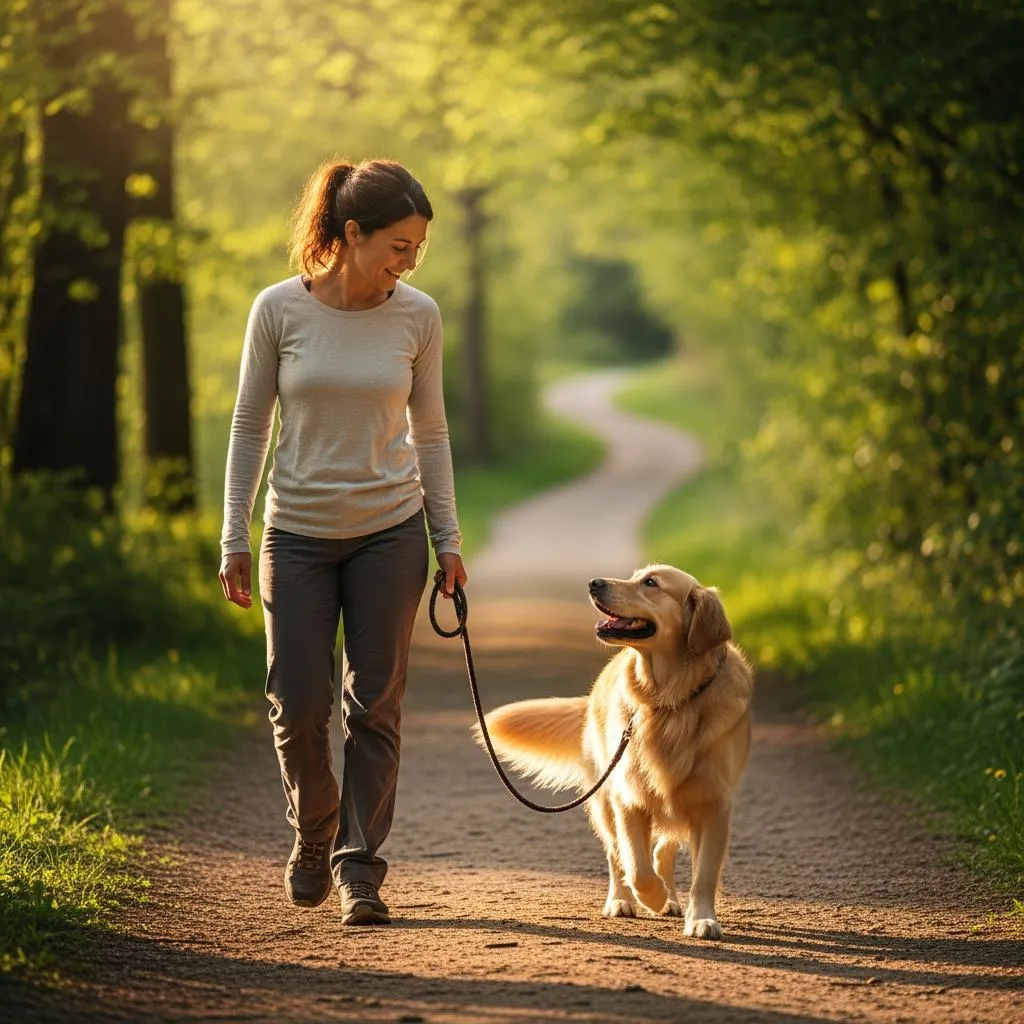
As David, whose formerly pulling Goldendoodle now walks beautifully beside him, shared: "The moment I realized we'd transformed wasn't when he stopped pulling completely. It was when he did lunge after a rabbit, then immediately looked back at me with an expression that seemed to say 'Sorry about that!' and returned to my side without me doing anything."
The Heart of the Matter: Walking as a Love Story
As Valentine's Day reminds us of connection, consider that few activities offer the bonding potential of a daily walk with your dog. When you move beyond the physical mechanics of leash walking into the realm of relationship and communication, something magical happens.
A peaceful walk isn't just about obedience or control – it's about two beings choosing to move through the world together in harmony. The loose leash becomes not just a training achievement but a physical manifestation of mutual respect, trust, and understanding.
The transformation from pulling to connection might take time, but each step forward is strengthening an invisible thread between you that extends far beyond your walks. The patience and consistency you demonstrate, the clear communication you establish, and the mutual respect you develop will influence every aspect of your relationship with your dog.
Like any love language, leash walking fluency requires practice, patience, and presence. But the reward – a walking partner who chooses connection over distraction – is one of the most beautiful expressions of the human-canine bond.
Call me at (248) 618-3258 or email [email protected] to discuss how we can transform your frustrating walks into connected journeys together. Our proven Canine Connection Compass methodology has helped hundreds of Metro Detroit dogs discover the joy of walking in harmony with their owners.
Remember, you don't have to dread walks or accept pulling as inevitable. A peaceful, connected walking relationship is possible for every dog and owner with the right approach.
Happy training!
Mandy Majchrzak
Owner and Head Trainer
Clever Canine Dog Training
Metro Detroit's Family Dog Training Specialists