How to Prepare Your Dog for Spring Outings
There's a moment every spring that catches dog owners off guard.
The weather finally turns. The kids want to walk to the bus stop with the dog. You decide to bring them along to your grandkid's Saturday soccer game. Someone suggests the farmers market and you think — why not? The dog would love it.
And then reality hits. Your dog is spinning on the leash, barking at strollers, lunging toward other dogs, or so overstimulated they can't settle for a single second. What was supposed to be a fun family outing turns into an embarrassing, exhausting ordeal. You go home frustrated. The dog goes home wired. And you quietly decide it's just easier to leave them behind.
Here's the thing — that scenario is almost always preventable. The problem isn't that your dog can't handle outings. The problem is that we tend to go from zero to full chaos without any preparation in between.
Spring is actually the perfect time to change that. Before the summer rush hits and every trail, park, and farmers market is packed, there's a window right now to get your dog ready. A few intentional weeks of preparation can be the difference between a dog you're proud to bring anywhere and one you feel you have to apologize for.
Why Busy Outdoor Environments Are So Hard for Dogs
To understand why spring outings go sideways, it helps to think about what your dog has been doing all winter.
For most dogs in Metro Detroit, winter means shorter walks, less exposure to crowds, fewer encounters with strangers and other dogs. By the time spring arrives, many dogs have essentially been in a lower-stimulation environment for months. Their threshold for handling excitement and novelty is lower than it was last fall.
Then we take them to a farmers market on a Saturday morning — hundreds of people, unfamiliar smells from every direction, dogs on leashes everywhere, kids running past, a band playing in the background — and we're surprised when they lose their mind.
It's not bad behavior. It's a dog whose nervous system is completely overwhelmed by a situation they weren't prepared for.
Dogs don't generalize experience the way humans do. A dog who handles your quiet neighborhood walk beautifully hasn't automatically learned to handle a crowded trail or a youth soccer sideline. Those are genuinely different environments to them — with different smells, sounds, movement patterns, and energy levels. Each new environment needs to be introduced gradually, with enough positive experience built up that the dog learns to associate busy places with good things rather than chaos and anxiety.
Start Quiet and Build Up — The Exposure Ladder
The most effective way to prepare your dog for busy spring outings is to think of environments on a ladder, from least stimulating to most stimulating, and work your way up one rung at a time.
Here's a practical example of what that ladder might look like:
Rung 1: A quiet park on a weekday morning — minimal foot traffic, no other dogs nearby, low energy environment. Practice loose leash walking, basic commands, and calm settle behavior here until your dog is consistently relaxed.
Rung 2: A slightly busier walking path during an off-peak hour. A few joggers, maybe another dog or two at a distance. Practice the same skills here. Watch your dog's body language. Are they relaxed and engaged with you, or are they scanning anxiously for the next thing to react to?
Rung 3: A neighborhood environment with more movement — like the school bus stop on a weekday morning, which tends to have kids, parents, bikes, and the general energy of morning chaos. Practice calm behavior here before you add a crowd.
Rung 4: A moderately busy environment like a quiet section of a farmers market early in the morning before the crowds arrive, or a hiking trail on a weekday when foot traffic is light.
Rung 5: Full summer chaos — the packed farmers market at 10am on a Saturday, the youth soccer sideline with twenty screaming kids, the popular trail on a sunny weekend afternoon.
The goal is never to avoid the top rungs. The goal is to build enough positive experience at each level that your dog has the emotional foundation to handle the next one.
Don't rush the ladder. If your dog is struggling at rung two, rung five is going to be a disaster. Move at your dog's pace, not your timeline.
Reading Your Dog's Stress Signals Before Things Go Wrong
One of the most valuable skills you can develop this spring is learning to read your dog's early stress signals — the ones that show up before the barking, lunging, or spinning starts.
By the time your dog is reacting, they've already been communicating discomfort for a while. Most owners miss the earlier signals because they're subtle.
Watch for these:
Yawning when they're not tired. A stress yawn looks just like a tired yawn but happens in stimulating environments. It's a self-calming behavior.
Lip licking with no food present. Another self-soothing signal. If your dog is licking their lips repeatedly while you're walking through a crowd, they're telling you something.
Whale eye. This is when you can see the whites of your dog's eyes — usually when they're turning their head but keeping their gaze fixed on something. It often precedes a more intense reaction.
Tight, high tail carriage. A tail held stiffly upright or flagging quickly is different from a relaxed, happy wag. Stiff tail movement often signals high arousal or anxiety.
Scanning. A dog whose head is constantly swiveling, checking everything around them, is a dog who isn't settled. They're in a state of alert that can tip into reactivity quickly.
Refusing treats they normally love. This is one of the clearest signals that your dog is over threshold. If your dog won't take their favorite treat in an environment, their stress level is too high for them to learn or enjoy themselves. That's your cue to create more distance or move to a quieter spot.
When you notice any of these signals, don't wait for the reaction. Move. Create more distance from whatever is causing the stress, give your dog a moment to decompress, and let their nervous system settle before continuing.
Specific Scenarios — What to Expect and How to Prepare
The School Bus Stop
This one catches people off guard because it seems so simple — just a quick walk to the corner, right? But bus stops concentrate a lot of stimulation into a small space: kids with backpacks, bikes, other dogs, the rumble and hiss of the bus itself, and the general chaos of morning energy.
How to prepare: Practice walking past groups of kids in lower-energy settings first. Walk near playgrounds at off-peak times. Get your dog comfortable with the sounds of traffic stopping and starting. Reward calm behavior consistently near movement and noise.
At the bus stop itself: Give yourself enough space. Standing at the edge of the group rather than in the middle of it gives your dog a buffer. Keep greetings with excited kids calm and brief — ask kids to pet gently rather than rushing toward your dog.
Youth Sports Sidelines
Soccer fields, baseball diamonds, and basketball courts on game day are genuinely demanding environments for dogs. There are sudden bursts of noise, kids running in unpredictable directions, other families with dogs, and a high-energy crowd that can tip a dog from excited to overwhelmed quickly.
How to prepare: Practice long settle behavior at home — can your dog lie calmly at your feet for 20 to 30 minutes? If not, that's worth working on before the sideline. Bring a mat or blanket your dog associates with settling. Practice near sports fields during quiet times before you try a game day.
At the game: Find a spot on the outer edge of the crowd rather than in the middle. Bring high value treats and reward calm behavior frequently. If your dog can't settle after 10 minutes, it's okay to walk them around the perimeter rather than expecting them to hold a down stay through the whole game.
The Farmers Market
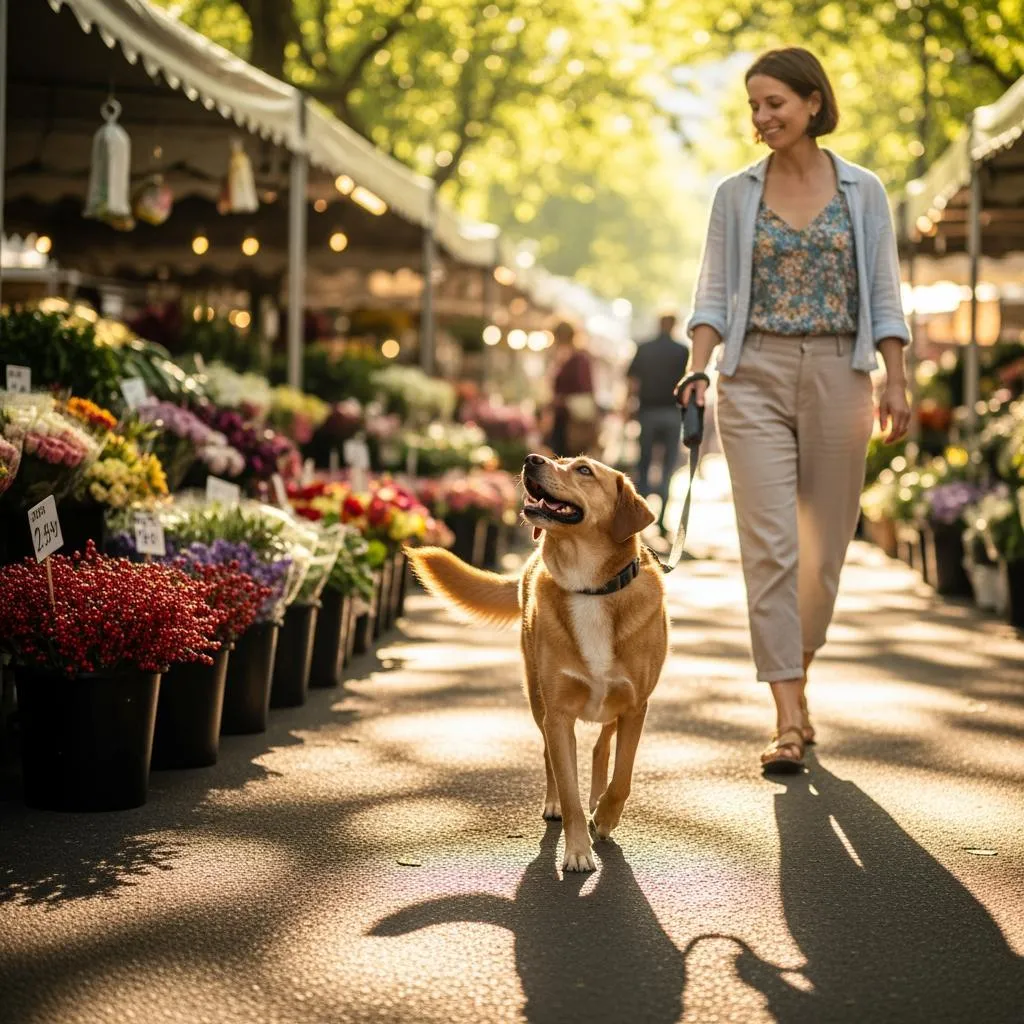
Farmers markets are one of the best environments to work toward — but one of the hardest to start with. The combination of food smells, crowds, unfamiliar dogs, and close quarters makes them extremely stimulating.
How to prepare: Start with early morning visits when the market is quieter. Walk the perimeter before going into the thick of it. Practice loose leash walking in similarly crowded spaces — busy parking lots, shopping center sidewalks — before market day.
At the market: Go early. Bring water for your dog. Take breaks at the edges of the crowd. Don't let every passerby stop to pet your dog — it's okay to say "they're in training today" and keep moving. A dog who has to greet forty strangers in an hour is a dog who is going to be exhausted and overstimulated long before you're done shopping.
Walking Trails and Hiking Paths
Trails bring their own unique challenges — unpredictable encounters around blind corners, off-leash dogs, cyclists, joggers appearing suddenly, and wildlife smells that can send a nose-driven dog into another dimension entirely.
How to prepare: Practice on quiet trails first. Build solid recall before you attempt popular trails — if your dog won't come reliably in the backyard, they are not ready for a trail encounter with an off-leash dog coming around a bend.
On the trail: Keep your dog on a four to six foot leash unless you're in a designated off-leash area and recall is rock solid. Learn to read what's coming and create space proactively. "On your left" from a fast-approaching cyclist gives you about two seconds — having your dog in a sit and rewarding calm behavior as the cyclist passes is something you can only pull off if you've practiced it.
What to Bring on Every Outing
A prepared outing is almost always a better outing. Before you head out:
High value treats in an easy-access pouch or pocket. Not kibble — something genuinely exciting like small pieces of chicken, cheese, or hot dog. Outings are harder than the living room and the rewards should reflect that.
A four to six foot leash. Not retractable. Retractable leashes give you almost no control in busy environments and teach dogs that pulling extends their range.
Water, especially as temperatures climb. A hot, thirsty dog is a stressed dog.
A clear exit plan. Know where you'll go if your dog hits their limit. Having a quiet spot picked out in advance means you're not scrambling when you need it.
The Bigger Picture
The goal of all of this isn't a perfectly behaved dog who never gets excited or needs management. The goal is a dog who can move through the world with you — who can join the family at the farmers market, cheer alongside you at the soccer game, and hit the trails on a Saturday morning without it turning into a stressful event.
That kind of dog doesn't happen by accident. They're built, one positive outing at a time, by an owner who took the time to prepare them before the chaos arrived.
Start now, while the trails are quiet and the markets are just opening for the season. By July you'll have a dog the whole family is excited to bring along.
If you're looking at the spring season and wondering whether your dog is ready for the outings you have planned — or if last year's outings didn't go the way you hoped — I'd love to help you put together a plan.
Call me at (248) 618-3258 or email [email protected] to talk through where your dog is and what they need to get ready for everything summer has in store. Our Canine Connection Compass methodology has helped hundreds of Metro Detroit dogs go from unpredictable in public to genuinely enjoyable companions wherever the family goes.
Spring is a fresh start. Let's make the most of it.
Happy training!
Mandy Majchrzak Founder, Clever Canine Dog Training Metro Detroit's Family Dog Training Specialists