Counter Surfing & Trash Diving: Reform Your Kitchen Criminal Dog
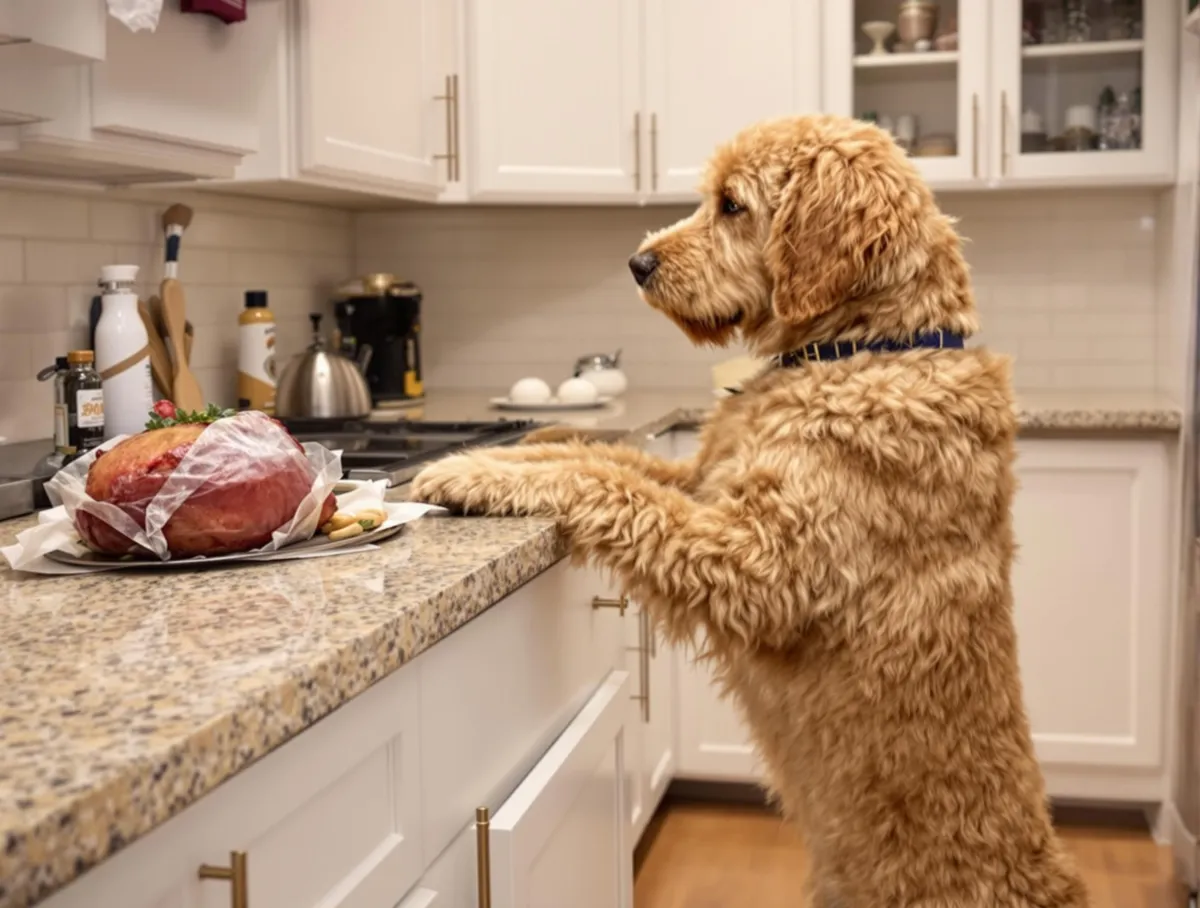
Picture this: You've spent hours preparing a beautiful holiday roast for your extended family gathering in your Warren home. You step away to change clothes before guests arrive, and when you return – disaster. Your Goldendoodle has somehow managed to pull the entire roast off the counter, leaving nothing but a mangled serving platter and your shattered dinner plans.
If this scenario sounds painfully familiar, you're not alone. Across Metro Detroit, from the suburban homes of Troy to the historic neighborhoods of Grosse Pointe, dog owners struggle with kitchen-based behavior problems that seem impossible to solve. Counter surfing, trash diving, and other kitchen crimes aren't just annoying – they're potentially dangerous for our beloved pets who might ingest harmful foods or packaging.
The good news? With the right understanding and approach, even the most determined kitchen criminals can be reformed. Let's dive into why these behaviors happen and how to transform your food-obsessed dog into your kitchen's best-behaved companion.
The Psychology Behind Your Dog's Kitchen Crimes
Before we jump into solutions, it's crucial to understand what's driving your dog's behavior. That understanding changes everything about how you approach the problem.
Evolutionary Hard-Wiring
"My dog knows better, but she steals food anyway! She's just being stubborn!"
I hear this frequently from frustrated clients across Metro Detroit. The reality is both simpler and more complex: your dog is doing exactly what thousands of years of evolution programmed them to do.
Dogs descended from opportunistic scavengers who survived by finding and consuming food whenever possible. In the wild, passing up an available food source could mean starvation. This instinct remains powerfully intact in our domestic pets, even when they're well-fed.
As one Ferndale client discovered with her Lab mix: "We thought Barley was being spiteful because he'd steal food right after we fed him. Understanding that his brain is literally wired to take advantage of food opportunities completely changed our perspective."
It's Not Personal
When your dog pulls that package of Better Made chips off the counter or raids the Sanders hot fudge you left out, they're not being deliberately disobedient. They're responding to:
Opportunity: Accessible food + no supervision = natural scavenging behavior
Reinforcement history: Every successful food heist reinforces the behavior
Aromatic temptation: A dog's sense of smell is approximately 10,000-100,000 times more sensitive than ours
This understanding connects directly to the Relationship pillar of our Canine Connection Compass. When we misinterpret normal dog behavior as deliberate disobedience, we damage the trust and connection that forms the foundation of successful training.
Step 1: Management - Setting Your Dog Up For Success
The first rule of behavior modification: prevent the unwanted behavior while you teach the desired one. For kitchen criminals, this means creating an environment where counter surfing and trash diving simply aren't possible during the training process.
Physical Management Solutions
📌 For counter surfing:
Clear counters completely when not in use (especially important in open-concept homes common in newer Oakland County developments)
Use baby gates to restrict kitchen access when cooking
Place cutting boards and food preparation away from counter edges
Consider a specific "food preparation" leash tether for persistent cases
📌 For trash diving:
Invest in a dog-proof trash can with a secure lid
Place trash under the sink with a childproof latch
Use a pull-out trash cabinet with a locking feature
For extreme cases, move trash to garage or laundry room temporarily
The McCormick family in Troy had a particularly clever solution for their persistent Labrador: "We installed a motion-activated air canister that creates a harmless puff of air when Max approaches the counter. After just three experiences, he decided counters weren't worth investigating anymore."
Management Is Not Failure
Many owners feel frustrated that they need management strategies, seeing them as admitting defeat. This couldn't be further from the truth. Management is an essential component of the training process that:
Prevents your dog from practicing unwanted behaviors
Reduces your frustration during the training period
Keeps your dog safe from dangerous foods or objects
Creates space for successful training experiences
Remember: even world-class dog trainers use management tools while building new behaviors!
Step 2: The Foundations of Kitchen Manners Training
With management in place, we can begin building the foundation skills that will transform your kitchen criminal.
The Place Command: Your Kitchen Training Secret Weapon
One of the most valuable behaviors you can teach your food-focused dog is a rock-solid "place" command. This means training your dog to go to a designated spot (usually a bed or mat) and stay there until released.
How to implement in the kitchen:
Position a dog bed or mat at the kitchen's perimeter where your dog can observe without accessing counters
Begin training the place command in low-distraction environments first
Gradually practice with increasing kitchen activity and food presence
Reward heavily for maintaining position, especially when food is visible
Melissa from Royal Oak shared: "Before training, I couldn't prepare a meal without Cooper jumping up constantly. Now he automatically goes to his place mat when I start cooking. The transformation has been incredible – we can actually host dinner parties again!"
This training directly applies the Boundaries pillar of our Canine Connection Compass. Clear boundaries create clarity for your dog, reducing anxiety and unwanted behaviors.
The "Leave It" Progression
The "leave it" cue is essential for any food-focused dog, but many owners implement it incorrectly.
The effective progression:
Start with low-value items in a controlled setting (closed hand technique)
Progress to open-hand challenges with moderate value items
Move to floor-based challenges with increasing value
Practice with food at counter height but controlled (on a plate you're holding)
Graduate to real-life counter scenarios with supervision
The key is teaching your dog that choosing NOT to take the food results in even better rewards – both edible rewards and relationship reinforcement.
💡 Pro Tip: Use the phrase "not for dogs" consistently when referring to human food. Dogs can learn specific phrases that indicate certain items are permanently off-limits.
Step 3: Advanced Training For The Determined Food Thief
If your dog has a long-established counter surfing habit, you'll need to employ more advanced techniques to create lasting change.
Counter Conditioning (Literally!)
Counter conditioning means changing your dog's emotional response to a trigger – in this case, food on counters.
The Peterson family in Birmingham had a Bernedoodle who seemed magnetically drawn to countertops. Their solution:
They set up controlled scenarios with food on the counter
They kept their dog on leash for safety and control
When their dog noticed the food but didn't jump, they immediately marked and rewarded that moment of restraint
They gradually increased difficulty by using more tempting foods and creating more realistic scenarios
"After three weeks of consistent counter conditioning, Winnie started looking at us for rewards whenever she noticed food on the counter, instead of trying to grab it," explained Mrs. Peterson. "It was like watching her brain rewire itself!"
Impulse Control Building Blocks
Many kitchen criminals struggle with general impulse control. These exercises build the mental muscles your dog needs:
Structured feeding routines:
Requiring a sit-stay before meals
Teaching a "wait" at the food bowl
Hand-feeding portions during training sessions
Duration challenges:
Gradually extending the time your dog must wait before getting a visible treat
"Dog zen" exercises where restraint leads to rewards
"It's your choice" games that reward voluntary self-control
These exercises connect directly to the Impulse Control pillar of our Canine Connection Compass. As one Sterling Heights client noted: "Once we improved Bella's overall impulse control, the counter surfing stopped on its own – it was just a symptom of her general lack of self-regulation."
Transformation Tales: Metro Detroit's Reformed Kitchen Criminals
The journey from kitchen criminal to culinary companion can be remarkable. These Metro Detroit success stories showcase the transformation process.
Max: The Garbage Connoisseur of Rochester Hills
When the Jacobson family first contacted us, they were at their wits' end with Max, their 3-year-old Labrador Retriever. Max had perfected the art of breaking into their kitchen trash can, regardless of the model they purchased or where they hid it.
"We tried everything," said David. "Bitter apple spray on the garbage, motion alarms, even putting the trash inside another room with a closed door. Somehow, Max always found a way. We once came home to find he'd chewed through the laundry room door to access the garbage."
Their turning point came when they realized they needed to address the underlying behavior, not just find better containment methods. Through our comprehensive approach:
They implemented appropriate management (a heavy-duty locking trash can)
They established clear kitchen boundaries using place training
They built Max's impulse control through structured daily exercises
They provided appropriate outlets for his scavenging instincts through puzzle toys and scent work
"The transformation didn't happen overnight," admits Carol. "But after about three weeks of consistent training, we started seeing a different dog. Instead of constantly plotting his next trash heist, Max would voluntarily go to his place mat when we entered the kitchen. Six months later, we can leave the trash unsecured and Max completely ignores it."
Bella: The Refrigerator Raider of Livonia
Bella, a cream-colored Goldendoodle with an innocent face and the skills of a master thief, had learned to open the refrigerator door using her paws and mouth in an impressive display of canine intelligence.
"We installed child locks, but she figured those out too," said owner Michael. "We'd come home to find deli meat packages dragged throughout the house and condiment bottles punctured on the floor. It was like living with a furry little burglar."
Bella's training journey involved:
Temporarily installing an additional physical lock on the refrigerator
Implementing a comprehensive counter conditioning program specific to the refrigerator
Teaching a solid "leave it" command with high-value food rewards
Addressing her overall relationship with food through structured meals and enrichment
"What surprised us most," shared Lisa, "was how quickly things improved once we understood the problem correctly. We'd been so focused on punishing Bella for the behavior that we never addressed why she was doing it or taught her what to do instead."
Today, Bella can be trusted around an open refrigerator and has transferred her problem-solving skills to appropriate puzzle toys instead.
When DIY Solutions Aren't Enough
While many kitchen criminal cases can be resolved with the techniques outlined above, some situations benefit from professional intervention.
Signs You Might Need Professional Help
⚠️ Consider reaching out to a professional trainer if:
Your dog has ingested dangerous items requiring veterinary care
The behavior persists despite consistent application of these techniques
Your dog shows signs of anxiety or compulsive behavior around food
The problem is creating significant household tension or conflict
Your dog guards stolen items with growling or other aggressive displays
The Clever Canine Difference
At Clever Canine, our approach to counter surfing and trash diving differs from traditional methods in several key ways:
We address all four pillars of the Canine Connection Compass:
Relationship (trust building between you and your dog)
Impulse Control (building overall self-regulation)
Communication (clear, consistent cues and expectations)
Boundaries (establishing clear kitchen rules and limitations)
We provide customized solutions based on your home layout and lifestyle:
Open concept kitchens require different approaches than closed kitchens
Families with children need strategies everyone can implement consistently
Work schedules and household routines inform our training recommendations
We focus on teaching owners, not just training dogs:
You'll learn to read your dog's subtle pre-surfing signals
You'll understand how to progress training at the right pace
You'll develop maintenance strategies to prevent regression
As Clinton Township client Sarah shared: "Other trainers just gave us a list of commands to teach. Clever Canine helped us understand our dog's behavior and transformed our relationship with him, which solved the counter surfing problem for good."
Your Path to Peaceful Food Preparation
Transforming your kitchen criminal is absolutely possible with the right approach. Remember these key points:
Understanding comes first: Your dog isn't being spiteful or deliberately disobedient
Management creates opportunity for success: Prevent the behavior while teaching alternatives
Training builds new habits: Place command, leave it, and impulse control form the foundation
Consistency is crucial: Everyone in the household must follow the same rules
Patience pays off: Most dogs show significant improvement within 2-4 weeks of consistent training
If you're struggling with counter surfing, trash diving, or any other kitchen-related training challenges, I'm here to help. Call me at (248) 618-3258 or email [email protected] to discuss how we can transform your kitchen criminal into a well-behaved companion.
Happy training!
Mandy Majchrzak
Owner and Head Trainer
Clever Canine Dog Training
Metro Detroit's Family Dog Training Specialists