The Consistency Crisis: Why Your Dog Training Isn't Sticking
Has this happened to you? Last week, your dog sat immediately when asked, came when called, and walked beautifully on leash. This week? It's like all that training evaporated into thin air. Your once-responsive companion now looks at you with that adorably confused head tilt when you ask for the same behaviors they nailed just days ago.
If you're nodding your head in frustrated agreement, you're experiencing what professional trainers call "the consistency crisis" – the hidden saboteur behind most training setbacks and the #1 dog training problem we've identified in 2025.
Understanding the Consistency Crisis
The consistency crisis isn't about your dog being stubborn or forgetful. It's a complex interplay of factors that undermine your training efforts when you're not looking. Think of it as the meta-problem behind nearly every training challenge you'll face.
This crisis manifests in three primary ways:
Family inconsistency: Different family members using different cues, enforcing different rules, or having different expectations
Environmental challenges: Your dog performs perfectly at home but falls apart in new environments
Training maintenance failures: The gradual erosion of training due to inconsistent practice and reinforcement
Let's explore why these issues happen and how to solve them once and for all.
The Science Behind Your Dog's "Selective Memory"
When your dog seems to forget their training, they're not being deliberately disobedient. Dog behavior is governed by neural pathways formed through consistent repetition and reinforcement. Each time your dog performs a behavior and receives a reward, that neural pathway strengthens. But these pathways require maintenance.
The Neuroscience of Dog Learning:
New behaviors require approximately 30 repetitions to form initial neural pathways
Consistent reinforcement strengthens these pathways
Inconsistent reinforcement creates confusion and weakens pathways
Environmental factors can inhibit access to learned responses
Take Bella, a chocolate Lab mix whose family was baffled by her seemingly selective memory. "She would sit perfectly when my husband asked, but completely ignore me," explained her owner Jamie. "We discovered he was using a hand signal with the verbal cue, while I was only using my voice. Once we standardized our approach, Bella's response became much more reliable."
This example highlights a critical truth: dogs don't generalize well. They don't automatically understand that "sit" means the same thing regardless of who says it, how they say it, or where they are. Each variation feels like a completely different request to your dog.
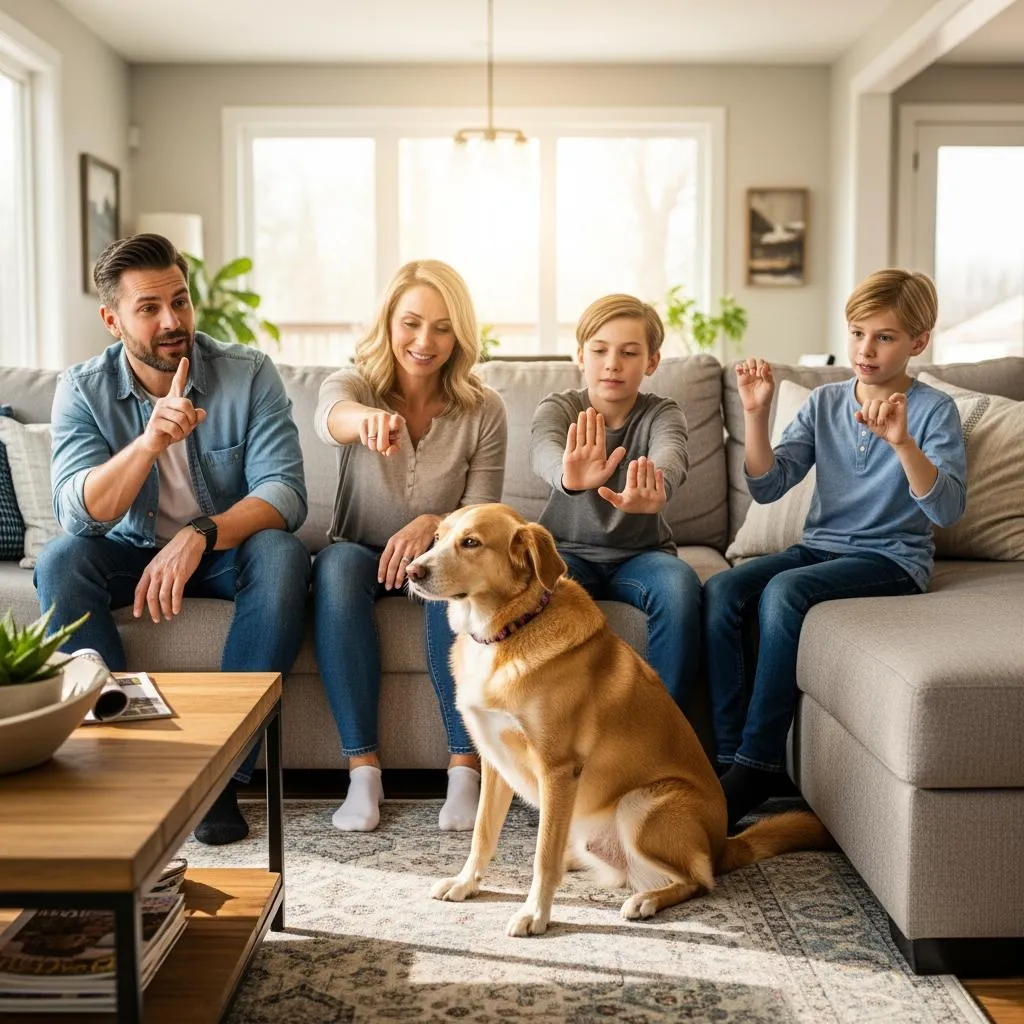
When Your Household Isn't on the Same Page
Family inconsistency is perhaps the most common saboteur of good training. Consider these scenarios:
Dad says "down" for lying down, Mom says "lie down," and the kids say "go to bed"
One family member allows the dog on the furniture, another doesn't
Someone consistently enforces the "no begging" rule while others slip food under the table
Different family members have different tolerance levels for jumping, barking, or pulling
Each inconsistency creates confusion for your dog about what the actual rules are. Imagine if traffic lights were sometimes red for stop and green for go, but other times the opposite. You'd be constantly uncertain and make mistakes – that's how your dog feels.
The Matthews family experienced this with their German Shepherd, Rex. "We couldn't figure out why he was becoming more disobedient by the week," said Michael Matthews. "During our training session, we realized my wife was allowing behaviors I was correcting, and our teenage son was using completely different commands. Rex wasn't being stubborn – he was confused!"
Their solution was surprisingly simple: a family meeting where everyone agreed on specific cues, rules, and expectations. They posted a "command cheat sheet" on the refrigerator, and within two weeks, Rex's behavior improved dramatically.
Family Alignment Strategies:
Hold a family training meeting to standardize commands and rules
Create a visible "command chart" showing agreed-upon cues
Establish clear boundaries about which behaviors are never acceptable
Implement a communication system for training progress
Consider filming each other to spot unconscious inconsistencies
The Environmental Generalization Challenge
Even when your family achieves perfect consistency at home, you might still face the environmental generalization problem. This is why your dog performs flawlessly in your living room but seems to develop selective hearing at the park.
Dogs don't automatically transfer learning from one environment to another. Each new location comes with different distractions, smells, sounds, and visual stimuli that can overwhelm their ability to access learned behaviors.
Casey, a Border Collie with impeccable recall in her backyard, would completely ignore her owner at the park. "It was like she didn't even know her name anymore," her owner explained. The solution wasn't more training at home – it was systematically practicing recall in progressively more challenging environments.
The Distraction Hierarchy:
Level 1: Quiet room at home with no distractions
Level 2: Different rooms of your home
Level 3: Your yard or immediate surroundings
Level 4: Quiet public spaces with minimal distractions
Level 5: Moderate distraction environments
Level 6: High-distraction environments with other dogs, people, and wildlife
The key is not to jump from Level 1 to Level 6 and then get frustrated when your dog fails. Instead, gradually work through each level, ensuring reliability before moving up.
"We started practicing Casey's recall in our front yard, then a quiet side street, then an empty field, and finally at the edge of the park," her owner shared. "By the time we were in the middle of the park with other dogs around, she had built up enough success to handle the distractions."
Dog Training's Hidden Saboteur: Inconsistent Maintenance
Even perfectly trained behaviors will deteriorate without maintenance. This explains why your dog's previously solid "stay" command gradually becomes shorter and less reliable.
Think of dog training like physical fitness. If you worked out intensively for a month and then stopped completely, your fitness would gradually decline. The same applies to your dog's training – it requires ongoing maintenance to stay strong.
Many owners make the mistake of intensive training followed by no practice, then express surprise when behaviors deteriorate. The reality is that all training requires some level of ongoing maintenance.
The Training Maintenance Principle:
New behaviors require daily practice
Established behaviors need reinforcement 2-3 times weekly
Even "mastered" behaviors should be practiced occasionally
Behaviors that are never reinforced will eventually extinguish
Marley, a Goldendoodle who had mastered polite greetings without jumping, gradually reverted to his old jumping habit. "We realized we'd stopped praising him for keeping four paws on the floor," his owner admitted. "Once we started acknowledging his good behavior again, the jumping stopped within days."
The Three Non-Negotiable Rules for Training Success
After working with hundreds of dogs and their families, we've identified three fundamental rules that, when followed consistently, resolve most training challenges:
Rule #1: Establish Clear, Consistent Cues and Expectations
Choose specific words for each command and stick with them
Decide exactly what each behavior should look like
Determine which behaviors are always unacceptable
Create clear criteria for rewards and corrections
Document your decisions so everyone can reference them
Rule #2: Ensure All Family Members Follow the Same Protocols
Hold regular family training discussions
Practice together to align your approaches
Create visual reminders of agreed-upon cues
Implement a system to catch and correct inconsistencies
Consider filming training sessions to identify discrepancies
Rule #3: Practice Progressive Environmental Challenges
Master behaviors in your home environment first
Systematically introduce distractions in controlled ways
Practice in new environments before expecting reliability there
Return to easier environments if your dog struggles
Celebrate and reinforce successes in challenging situations
When families commit to these three rules, the transformation can be remarkable. The Andersons were at their wit's end with their reactive Beagle mix who seemed impossible to control on walks. "We were getting different results depending on who walked him and where we went," they explained. After implementing our three rules, they reported: "It's like we have a different dog. Everyone uses the same approach now, and we've gradually worked up to busier walking routes. The consistency made all the difference."
Creating Your Consistency Action Plan
Knowing what to do is only half the battle – implementing it consistently is where many families struggle. Here's a practical action plan to overcome the consistency crisis:
Week 1: Alignment
Hold a family meeting to standardize cues and expectations
Create a command chart and post it visibly
Film each family member giving the same commands
Identify and correct inconsistencies
Establish a communication system for training updates
Week 2-3: Home Mastery
Practice core behaviors daily in home environment
Ensure all family members participate
Document progress and challenges
Address any persistent inconsistencies
Celebrate improvements with the whole family
Week 4-6: Environmental Expansion
Create a list of progressively challenging environments
Practice core behaviors in each new environment
Return to easier environments if struggles occur
Track which environments prove most challenging
Gradually increase distraction levels
Ongoing Maintenance:
Schedule regular practice sessions for core behaviors
Hold monthly family training check-ins
Periodically film training sessions to catch drift
Revisit challenging environments regularly
Adjust your approach based on results
Troubleshooting Common Consistency Challenges
Even with the best intentions, consistency challenges can arise. Here are solutions to common problems:
Challenge: Family members forget the agreed-upon cues
Solution: Post command charts in multiple locations and create a family group chat for quick reference questions.
Challenge: Different family members have different standards
Solution: Define success criteria specifically (e.g., "sit means the dog's bottom touches the floor for at least 3 seconds") and practice together.
Challenge: Your dog performs inconsistently in new environments
Solution: You've likely advanced too quickly. Step back to an easier environment and rebuild success gradually.
Challenge: Training seems to work, then deteriorates
Solution: Implement a maintenance schedule with calendar reminders for practice sessions.
Challenge: Family members disagree about training methods
Solution: Seek professional guidance together to develop a unified approach everyone can support.
The Path Forward: Consistency Creates Transformation
The good news about the consistency crisis is that it's entirely solvable. Unlike genetic or deep-seated behavioral issues, consistency problems can be resolved through thoughtful planning and family commitment.
When the Wilson family came to us with their "untrainable" Shepherd mix, they were considering rehoming him. "We'd tried everything," they said. But upon observation, we discovered dramatic inconsistencies in how different family members interacted with their dog. After implementing our consistency protocol, they reported: "The transformation has been unbelievable. He's the dog we always hoped he would be, and all it took was getting everyone on the same page."
Your dog isn't being stubborn, forgetful, or difficult when they seem to forget their training. They're responding to the inconsistency in their environment – something you have the power to change.
Call me at (248) 618-3258 or email [email protected] to discuss how we can help your family overcome the consistency crisis. Our proven Canine Connection Compass methodology has helped hundreds of Metro Detroit dogs achieve reliable behavior through family consistency training.
Make 2026 the year you finally solve the consistency puzzle. Our January class schedule is now open with special "Fresh Start" family training sessions designed specifically to address consistency challenges.
Happy training!
Mandy Majchrzak
Owner and Head Trainer
Clever Canine Dog Training
Metro Detroit's Family Dog Training Specialists